

Many people wonder whether the name Tristan has a Greek meaning or connection to Greek history and mythology. Although Tristan is not a Greek name, it is often searched alongside Greek origins because of its long history and widespread use across different cultures. Understanding where the name truly comes from can help clear up common misconceptions and reveal its rich historical background.
In this guide to What Does Tristan Mean in Greek?, you’ll explore the true origin of the name, its traditional meaning, and whether it has any links to the Greek language or mythology. Whether you’re researching baby names, curious about its cultural significance, or looking for accurate information, this article provides a clear and informative overview of Tristan and its fascinating history.
The Greek Etymology of Tristan
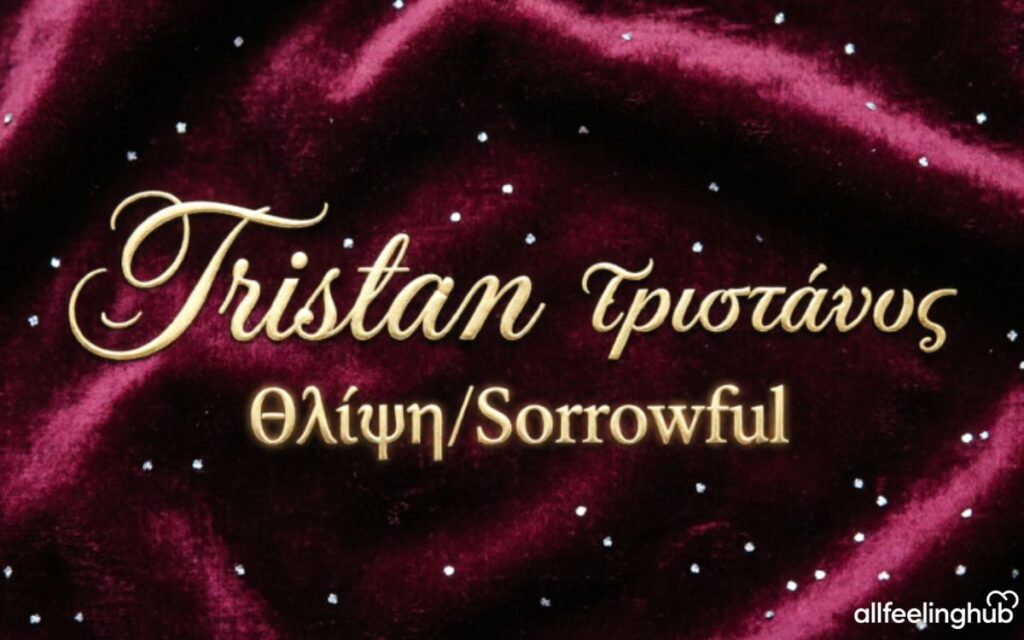
The name Tristan does not have a primary Greek etymology. This is one of the most important clarifications for anyone researching the name. While Greek has influenced an enormous number of names in the Western naming tradition, Tristan is not among those that trace their roots to the ancient Greek language.
The most widely accepted linguistic origin of Tristan is Celtic, specifically from the Brythonic Celtic languages of what is now Wales, Cornwall, and Brittany in northwestern France. The name derives from the Old Welsh or Cornish name Drystan or Drustan, which itself is believed to connect to a Proto-Celtic root meaning noise or tumult, or alternatively to a root related to the concept of strife or din.
The Historical Origin of the Name Tristan
The historical origin of the name Tristan is firmly rooted in the legendary traditions of early medieval Celtic Britain. The name appears in its oldest recorded form as Drystan or Drustan, found in early Welsh manuscripts and in inscriptions from the region of Cornwall and Scotland dating as far back as the sixth and seventh centuries CE.
The earliest appearance of a person named Drystan in historical record is a sixth-century inscription found in Cornwall, England, on a stone known as the Tristan Stone near Fowey. The inscription reads in Latin: Drustanus hic iacit Cunomori filius, meaning Here lies Drustanus, son of Cunomorus.
This inscription is believed by some scholars to reference the historical figure whose legend eventually became the medieval romance of Tristan and Iseult.
The Latin Connection: Why Tristan Is Linked to Tristis
The most persistent false etymology of the name Tristan connects it to the Latin word tristis, meaning sad, sorrowful, or gloomy. This connection, while etymologically unsupported as an origin, is culturally significant because medieval writers themselves promoted it and because it profoundly shaped how the name was understood and used throughout the Middle Ages and beyond.
Medieval literary tradition frequently engaged in what scholars call folk etymology, the practice of explaining a name’s meaning by reference to words it sounds similar to rather than by tracing its actual linguistic heritage. When the legend of Tristan and Iseult was being composed and circulated in the twelfth century, French-speaking authors noted the resemblance between Tristan and tristis, and they made this apparent connection thematically central to the story.
The Connection Between Tristan and Greek Language
The connection between Tristan and the Greek language is indirect, thematic, and cultural rather than etymological. Understanding this distinction is essential for anyone seeking an accurate understanding of the name’s origins.
In terms of direct linguistic connection, Greek does not appear in the name’s genealogy. The sounds of Tristan do not derive from Greek phonological roots, the name does not appear in ancient Greek texts, and no credible etymological dictionary traces the name to a Greek source.
However, Greek does intersect with the name Tristan in several meaningful indirect ways. First, the Latin word tristis, which sounds similar to Tristan and which medieval writers used to explain the name, is itself related to Greek aesthetic concepts. The Greek word tristia and related terms appear in Greek literary tradition in the context of lamentation, grief, and elegiac poetry. The Roman poet Ovid’s famous work Tristia, a collection of sorrowful elegies, demonstrates how the Latin tristis and related concepts connected to Greek lyric and elegiac traditions.
Tristan vs. Greek Names: Similarities and Differences
Comparing Tristan to genuine Greek names reveals both surface similarities that explain the confusion and fundamental differences that demonstrate the name’s distinct origin.
Greek names typically follow predictable structural patterns that reflect the language’s morphological conventions. Many Greek names end in characteristic Greek suffixes such as -os, -is, -on, -as, or -ia for masculine and feminine forms respectively. Examples include names like Alexandros, Nikolaos, Christos, Anastasia, Katerina, and Dimitris. The sound and structure of Tristan does not follow these patterns.
Greek names also frequently derive from identifiable Greek semantic roots with clear meanings. Alexandros means defender of men from alexein and aner. Nikolaos means victory of the people from nike and laos. Theodore means gift of God from theos and doron. The name Tristan does not contain identifiable Greek semantic components.
Cultural Significance of Tristan in Greek History
The name Tristan does not hold a significant place in the historical naming traditions of Greek culture, but it has acquired cultural significance in modern Greek society through the global spread of the name and through Greece’s participation in Western European cultural traditions.
In ancient Greek history, the name Tristan is entirely absent. Greek antiquity had no cultural knowledge of the Celtic naming traditions that produced Tristan, and the legends associated with the name did not circulate in the ancient Greek world. The geographic and cultural distance between the Celtic peoples of Britain and the Greek civilizations of the Mediterranean meant that there was no ancient pathway through which the name could have entered Greek cultural consciousness.
Modern Usage of Tristan in Greek-Speaking Countries
In contemporary Greece and Cyprus, the name Tristan occupies an interesting position as a foreign name that is recognized, occasionally used, and increasingly familiar without having been fully assimilated into the mainstream Greek naming tradition.
Greek naming tradition has historically been strongly conservative, with most names drawn from the Orthodox Christian calendar of saints’ names, from ancient Greek mythology and history, and from family naming traditions that perpetuate ancestral names across generations. The Orthodox Church calendar provides an enormous repertoire of names associated with saints and martyrs, and many Greek families observe the tradition of naming children after saints rather than choosing names for aesthetic reasons.
Why Parents Choose Tristan: Greek Heritage Perspective
Greek parents who choose the name Tristan for their children typically do so for reasons that reflect the intersection of traditional Greek values with modern international cultural influences.
The name’s literary and romantic associations appeal to Greek parents who are familiar with the great love stories of Western literature. The legend of Tristan and Iseult, with its themes of passionate and enduring love, resonates with the Greek cultural value placed on intense emotional experience and lyric expressiveness. Greece has its own rich tradition of tragic love stories from ancient tragedy to Byzantine romance, and the name Tristan connects to that tradition at a thematic level even if not at a linguistic one.
The name’s cross-cultural functionality is also appealing to Greek families with international connections or aspirations. A child named Tristan can move between Greek and non-Greek contexts with a name that functions naturally in both, an important consideration for Greek families with relatives in the diaspora or with professional ambitions that extend beyond Greece.
Famous People Named Tristan with Greek Heritage

While the name Tristan is not common in the Greek cultural tradition, several notable individuals of Greek heritage or Greek connection have carried the name, reflecting the gradual spread of Western European naming traditions into Greek cultural communities worldwide.
In the Greek diaspora communities of Australia, the United States, Canada, and Western Europe, the name Tristan appears with greater frequency than in Greece itself. Greek-Australian and Greek-American families, influenced by the dominant naming cultures of their countries of residence while maintaining connection to their Greek heritage, have been among the first Greek communities to adopt Western European names like Tristan.
Tristan Name Variations Across Greek Regions
The name Tristan does not have traditional regional variations within Greece in the way that names indigenous to the Greek naming tradition do, since it has not been part of Greek naming culture long enough to develop regional adaptations. However, the way the name is rendered, pronounced, and adapted does show some variation across different Greek-speaking communities.
In mainland Greece, the name is most commonly transcribed as Τρίσταν in the Greek alphabet, following standard transliteration conventions. The pronunciation in standard Modern Greek would emphasize the first syllable, producing TREE-stan, with the Greek r sound being slightly rolled compared to the English pronunciation.
In Cyprus, where Greek naming traditions have been historically more conservative and more influenced by Byzantine practice, the name Tristan is even less common than in mainland Greece. When it appears, it typically follows the same transliteration pattern used in mainland Greece.
The Symbolism Behind Tristan in Greek Culture
While Tristan does not have ancient Greek symbolic associations, the name has acquired symbolic resonance in modern Greek cultural consciousness through its associations with the legendary tradition and through the universal human themes those associations represent.
In Greek cultural understanding, the name Tristan most powerfully evokes the theme of tragic love, a theme that resonates deeply in a culture that produced some of the world’s greatest tragedies and that has always placed high cultural value on the expression of intense emotional states. The love story of Tristan and Iseult speaks to the same human experience that Greek tragedy explored in stories of Orpheus and Eurydice, of Pyramus and Thisbe, and of the doomed romances of the mythological tradition.
How to Spell Tristan Correctly
The standard English spelling of the name is T-R-I-S-T-A-N, with the emphasis on the first syllable. This spelling is derived from the French medieval spelling of the name and has been the dominant form in English since the medieval period.
Several spelling variations exist across different languages and cultural contexts. In Welsh and Cornish, the older Celtic form of the name is spelled Drystan or Drustan, reflecting the original Celtic phonology. In French, the name is spelled Tristan, identical to the English form. In German, it is also Tristan. In Spanish and Italian, the name is typically rendered as Tristán with an accent mark, indicating the stress pattern in those languages.
In Greek transliteration, the name is written Τρίσταν in the Greek alphabet, using tau, rho, iota, sigma, tau, alpha, nu. The accent mark in Greek indicates the stress on the first syllable..
How to Pronounce Tristan in Greek

In Modern Greek, the name Tristan is pronounced with the stress on the first syllable, producing a sound approximately equivalent to TREE-stan. The Greek pronunciation differs from the English in several specific ways that reflect the phonological conventions of Modern Greek.
The initial T in Greek is pronounced as an unaspirated dental stop, similar to the English t but without the small puff of air that English speakers typically produce before a vowel. This gives the Greek pronunciation of the name a slightly more precise, forward sound at the beginning.
The Greek R is a flap or trill, produced with the tongue touching the ridge behind the upper teeth rather than the approximant sound used in standard English. This gives the Greek pronunciation of Tristan a slightly rolled quality on the R that is absent in most English pronunciations.
Tristan’s Role in Greek Literature and Poetry
The name Tristan has entered Greek literature and poetry primarily through the translation and adaptation of Western European literary works rather than through an indigenous Greek literary tradition featuring the name.
Modern Greek translators and poets have engaged with the medieval romance of Tristan and Iseult, producing Greek-language versions that have introduced the name and its legendary associations to Greek literary audiences. The great nineteenth and twentieth-century Greek engagement with Western European Romanticism, which placed enormous value on the Arthurian legends and the medieval romance tradition, created an audience for these stories in Greece and contributed to the cultural familiarity of the name.
Contemporary Greek poets and novelists occasionally use the name Tristan for characters in works that engage with the themes of tragic love, doomed romance, and the conflict between personal passion and social expectation. In this usage, the name functions as a cultural allusion that Greek readers familiar with the legendary tradition will recognize.
The Greek Influence on Tristan’s Meaning Over Time
While Greek is not the origin of the name Tristan, Greek cultural and philosophical influence has shaped how the name’s meaning has been understood and elaborated over the centuries in ways worth examining.
The medieval European intellectual tradition, which developed the legendary framework around the name Tristan, was deeply influenced by Greek philosophy, particularly Platonic and Neoplatonic concepts of love. The idea of eros as a transcendent force that overwhelms rational control, the concept of the soul’s longing for its perfect counterpart, and the philosophical treatment of beauty and desire that runs through Greek philosophical tradition all contributed to the intellectual atmosphere in which the Tristan legend was composed and interpreted.
Medieval poets and theologians drew on Greek philosophical categories of love, including the Platonic distinction between lower physical love and higher spiritual love, in their interpretation of the Tristan story. This Greek philosophical inheritance shaped how readers and listeners understood what the name represented: not merely romantic passion but a deeper metaphysical longing.
Spiritual Meaning of the Name Tristan
The spiritual meaning of the name Tristan draws from several traditions that have intersected in the name’s long cultural history. While the name is not biblical and does not appear in sacred texts of the major world religions, it has accumulated spiritual significance through its legendary associations and through the religious frameworks of the medieval world that told and retold the story of Tristan and Iseult.
In the medieval Christian world, the Tristan legend was read by some interpreters as an allegory of the soul’s passionate longing for union with God. The intensity of Tristan’s love for Iseult, its transcendence of normal social and moral boundaries, and its ultimate resolution in death were understood by mystical interpreters as a reflection of the soul’s absolute and consuming love for the divine.
This spiritual interpretation gives the name Tristan a meaning related to passionate spiritual seeking, to the willingness to sacrifice everything for the highest love, and to the understanding that the most profound human experiences point beyond themselves to a transcendent reality.
In a more general spiritual sense, the name Tristan is associated with depth of feeling, authenticity of experience, and the courage to love completely and without reservation. These qualities connect to spiritual values across multiple traditions, including the Islamic concept of ishq as divine love, the Buddhist emphasis on full presence in experience, and the Christian mystical tradition of total surrender to love.
The sadness associated with the name through its folk etymology also carries spiritual weight in traditions that recognize grief as a form of love and that understand mourning as evidence of the depth of connection between souls.
Personality Traits Associated with Tristan
The personality traits culturally associated with the name Tristan reflect both the legendary figure and the aesthetic and emotional qualities the name carries.
People named Tristan are frequently described by those who know them as sensitive and emotionally intelligent, with a capacity for deep feeling that distinguishes them from more emotionally reserved contemporaries. This association connects directly to the legendary Tristan’s characteristic depth of emotion and his capacity for passionate, consuming love.
Creativity is another trait frequently associated with the name. The legendary Tristan was renowned as a musician, poet, and storyteller as well as a warrior, and this multidimensional artistic identity has contributed to an association between the name and creative talent. People named Tristan often show strong aesthetic sensibilities and artistic inclinations.
Independence and a somewhat romantic worldview are also commonly associated with the name. The legendary Tristan was always somewhat apart from the social order, always in tension with the conventional expectations of his world, and people who carry his name often show a similar tendency toward individualism and a preference for authentic experience over social convention.
Names Similar to Tristan

Several names share phonetic, thematic, or cultural similarities with Tristan and may appeal to parents considering the name.
Celtic names similar to Tristan: Kieran, Declan, Rowan, Cormac, Brennan, Dorian, and Connell share the Celtic heritage and similar sound qualities. These names carry the same geographic and cultural origin without the specific legendary associations.
Names with similar romantic literary associations: Lancelot, Gawain, Percival, Roland, and Leander share the romantic legendary associations that make Tristan appealing to parents drawn to names from medieval romance and classical legend.
Names with similar meaning: Names associated with melancholy, sadness, or emotional depth include Dorian, Damien, and Leander. Names associated with tumult or strife, which reflects the Celtic etymology, include Brian and Duncan.
Greek names with similar aesthetic qualities: Alexandros, Leonidas, and Orion share the strong consonant structure and romantic historical associations that make Tristan appealing, while being genuinely Greek in origin.
Names that pair well with Tristan: For siblings or middle name combinations, names that complement Tristan include Luca, Sebastian, Julian, Maximus, Elara, Seraphina, Isolde, and Evangeline.
Feminine forms of Tristan: While Tristan is typically masculine, feminine adaptations include Tristana and Trista, both of which carry the same legendary associations.
Is Tristan a Good Baby Name?
Tristan is an excellent baby name by virtually every measure used to evaluate names for children. It combines genuine historical depth with contemporary appeal, strong phonetic qualities with cultural resonance, and distinctiveness with international functionality.
Phonetic appeal: Tristan has strong phonetic qualities that make it satisfying to say and easy to remember. The combination of the resonant initial consonant cluster, the clean vowel in the first syllable, and the balanced ending creates a name that sounds equally good spoken softly or announced firmly.
Distinctiveness without eccentricity: Tristan is distinctive enough to stand out but not so unusual as to be burdensome for the child. It appears regularly enough in naming statistics to be recognized and taken seriously without being so common that multiple children share it in any given classroom.
Cross-cultural functionality: Tristan works well across multiple languages and cultural contexts. It is recognizable and pronounceable in English, French, Spanish, German, Italian, and numerous other languages, making it an excellent choice for families with international connections or aspirations.
Literary and historical depth: Parents who value names with genuine cultural and historical significance will find Tristan richly satisfying. The name connects to one of the great love stories of Western literature and to a legendary tradition that spans more than a thousand years.
Aging well: Tristan works well at every stage of life, from childhood through professional adulthood. It sounds appropriate on both a child and an adult, and it shortens naturally to Tris for those who prefer a nickname.
Is Tristan a Biblical or Greek Name? Complete Origin Analysis

Tristan is neither a Biblical name nor a Greek name. This is the most important clarification in the complete origin analysis of the name.
Not Biblical: Tristan does not appear anywhere in the Hebrew Bible, the New Testament, the Deuterocanonical books, or any accepted scriptural tradition. The name did not exist in the ancient Near Eastern cultural world that produced the Biblical texts. It cannot be found in the Old Testament, in the New Testament, in the writings of the early Church Fathers, or in the liturgical calendar of the ancient Christian church.
Not Greek: As established throughout this article, Tristan does not derive from the Greek language and does not appear in ancient Greek texts, mythology, or naming tradition. The name’s phonetic resemblance to certain Greek and Latin words is a surface similarity without etymological depth.
What Tristan actually is: Tristan is a Celtic name with Brythonic origins, derived from the early medieval naming traditions of Wales, Cornwall, and Brittany. Its oldest documented form is Drystan or Drustan, found in the Celtic-speaking world of post-Roman Britain. The name entered broader European consciousness through the French medieval romance tradition in the twelfth century.
The folk etymology: The connection to the Latin tristis, meaning sad, is a medieval folk etymology promoted by the writers of the Tristan legend rather than a genuine linguistic origin. It became culturally significant without being etymologically accurate.
Complete origin summary: Celtic in origin, French in transmission, Latin in folk etymology, universal in literary association, and international in modern usage.
The Evolution of the Name Tristan Through History
The evolution of the name Tristan through history follows a fascinating trajectory from obscure Celtic naming tradition to international recognition across more than fifteen centuries.
Sixth to eighth centuries CE: The name exists in its original forms as Drystan and Drustan among the Brythonic Celtic peoples of Britain. It appears in inscriptions and Pictish king lists, suggesting a name of moderate currency in the Celtic world.
Ninth to eleventh centuries: The legendary tradition surrounding a figure named Drystan begins to develop in Celtic storytelling traditions, particularly in Cornwall, Wales, and Brittany. The name begins its transformation from historical to legendary.
Twelfth century: The legend of Tristan and Iseult reaches its first great literary flowering in French, with poets including Béroul and Thomas of Britain composing influential versions. The name becomes Tristan in its French form, and the folk etymology connecting it to tristis is established.
Thirteenth century: Gottfried von Strassburg produces his celebrated German version, and the legend spreads throughout literate European culture. The name Tristan becomes known across Western Europe.
Fourteenth to eighteenth centuries: The name continues in use primarily due to its legendary associations. It appears in literature, heraldry, and occasional naming practice but is not particularly common.
Nineteenth century: Romanticism revives interest in medieval legend, and Richard Wagner’s opera Tristan und Isolde of 1865 brings the name to renewed international prominence. The name experiences a cultural renaissance.
Twentieth and twenty-first centuries: Tristan achieves genuine popularity as a given name in English-speaking countries, France, Germany, and increasingly globally.
Ancient Languages That Influenced the Name Tristan
The name Tristan was shaped by several ancient and medieval languages, each contributing to different aspects of its sound, meaning, and cultural resonance.
Proto-Celtic and Brythonic Celtic: The foundational language that produced the name. Proto-Celtic contributed the root from which Drystan derived, likely related to noise, tumult, or strife. Brythonic Celtic, the language ancestor of Welsh, Cornish, and Breton, gave the name its oldest documented forms.
Latin: Latin contributed the folk etymology through the word tristis, meaning sad. Latin was the prestige language of medieval European scholarship, and medieval writers’ deployment of the tristis connection gave the name its most widely known apparent meaning.
Norman French: The most important language in the transformation of the name from its Celtic form to its modern form. Norman French writers of the twelfth century adapted Drystan to Tristan, establishing the spelling and pronunciation that became standard.
Old English: Old English naming traditions interacted with Celtic naming practices in Britain, contributing to the name’s survival and transmission in the post-Roman British context.
Greek (indirect): Greek influenced the intellectual and literary traditions through which the Tristan legend was interpreted and elaborated, particularly through Greek philosophical concepts of love that medieval writers applied to the story.
Is Tristan a Name Found in Ancient Greece?

No. Tristan is definitively not a name found in ancient Greece. This can be stated with complete confidence based on the available evidence from ancient Greek texts, inscriptions, and historical records.
Ancient Greek naming practices drew from a specific cultural and linguistic world that was entirely separate from the Celtic naming traditions that produced Tristan. Greek names reflected Greek mythology, Greek religious practice, Greek philosophical concepts, and the phonological patterns of the Greek language. None of these produced a name resembling Tristan.
The ancient Greeks had no cultural knowledge of the Celtic peoples of Britain and western France in the period when the name Drystan was first in use. While some contact between Greek merchants and the people of western Europe did occur in the ancient period, particularly through the Greek colony of Massalia in what is now Marseille, this contact did not extend to the exchange of naming traditions.
Tristan in European Naming Traditions
Tristan occupies a distinctive place in European naming traditions as a name that transcended its Celtic origins to become genuinely pan-European through the power of its legendary associations.
Britain: The name has been used in Britain since its Celtic origins, maintaining continuous if sometimes sparse presence in naming records from the medieval period to the present. It is most common in Wales and Cornwall, the regions most closely connected to the original Celtic tradition.
France: France played the most important role in transmitting the name across Europe. The French versions of the Tristan legend were the most influential literary works in the medieval West, and French cultural prestige carried the name throughout European royal courts and literate society.
Germany: The German engagement with the legend, culminating in Gottfried von Strassburg’s thirteenth-century masterpiece and Wagner’s nineteenth-century opera, made Tristan a culturally significant name in German-speaking countries.
Spain and Portugal: The name appears in Iberian naming traditions as Tristán with the accent, influenced by the French literary tradition and the Iberian engagement with Arthurian legend.
Italy: The name appears in Italian form as Tristano in medieval Italian literature, including in the works of Italian writers who engaged with the Arthurian tradition.
Eastern Europe and Greece: The name reached these regions much later, primarily through the globalization of Western European cultural products in the nineteenth and twentieth centuries.
Why Tristan Is Often Mistaken for a Greek Name

The mistaken identification of Tristan as a Greek name is understandable given several factors that create confusion for non-specialists.
Phonetic resemblance to Greek-sounding words: The sequence of sounds in Tristan, particularly the -ist- combination, appears in numerous English words derived from Greek, such as artist, scientist, mystic, and lyricist. This association leads some people to assume that names with similar sound patterns are also Greek in origin.
The Latin tristis confusion extended to Greek: Since Latin borrowed heavily from Greek and since many people know that Latin and Greek are closely related ancient languages, the association of Tristan with the Latin tristis sometimes extends to an assumption of Greek derivation.
General association of European classical names with Greece: In popular culture, ancient history and classical learning are often loosely identified with Greece. Names that sound classical or ancient to English-speaking ears are sometimes attributed to Greece even when their origins lie elsewhere.
The academic tradition: In some naming dictionaries and popular name guides, the name Tristan has been given inaccurate etymologies that attribute Greek origins. These errors propagate through secondary sources and become established in popular understanding.
Lack of familiarity with Celtic languages: Most people have considerably more exposure to Greek and Latin than to Celtic languages. This asymmetry means that unfamiliar names are more likely to be attributed to the familiar classical languages than to the less familiar Celtic tradition.
The Difference Between Greek and Celtic Name Origins
Understanding the fundamental differences between Greek and Celtic name origins helps clarify not only the case of Tristan but the broader landscape of European naming traditions.
Geographic origin: Greek names originate in the Mediterranean world, specifically in the Greek-speaking communities of the Aegean, the eastern Mediterranean, and the lands where Greek language and culture spread through colonization and conquest. Celtic names originate in the Atlantic and central European world, specifically among the Celtic-speaking peoples whose historical heartlands lay in what is now France, Britain, Ireland, and parts of central Europe.
Linguistic structure: Greek names follow the morphological patterns of the Greek language, with characteristic suffixes, compound formations, and semantic roots drawn from Greek vocabulary. Celtic names follow the phonological and morphological patterns of the Celtic language family, with initial mutations, compound formations, and semantic roots entirely different from Greek.
Cultural associations: Greek names typically connect to Greek mythology, Greek history, Greek religion, or Greek philosophical concepts. Celtic names typically connect to Celtic mythology, Celtic religious practice, or Celtic cultural values and natural phenomena.
Sound patterns: Greek names tend toward open vowel sounds, characteristic suffixes, and the specific consonant patterns of Greek phonology. Celtic names tend toward consonant clusters, specific vowel patterns, and initial mutation patterns that create distinctive sounds quite different from Greek.
Is Tristan a Timeless or Modern Name?
Tristan occupies the relatively rare position of being genuinely both timeless and contemporary, a name with authentic ancient roots that also feels fully at home in the twenty-first century.
The case for timelessness: The name has documented use going back to at least the sixth century CE, and the legendary tradition associated with it has been continuously alive in Western culture for over a millennium. It appears in medieval manuscripts, Renaissance literature, Romantic era opera, and contemporary film and television. A name with this range of appearances across different historical periods has earned the designation of timeless.
The case for contemporary appeal: Tristan ranks among the most popular names of the late twentieth and early twenty-first centuries in multiple English-speaking countries. It has appeared on baby name popularity charts in the United States, United Kingdom, Australia, and Canada with increasing frequency since the 1980s, suggesting that it resonates powerfully with contemporary naming sensibilities.
Why it works in both dimensions: The qualities that make Tristan timeless are the same qualities that make it contemporary. Its phonetic appeal, its literary depth, its romantic associations, and its balance between distinctiveness and accessibility are qualities that transcend specific historical moments and speak to persistent human values and aesthetic preferences.
For parents wondering whether a name will feel dated in twenty years, Tristan’s demonstrated staying power across more than a millennium of European culture provides substantial reassurance.
What Does the Name Tristan Mean in Different Cultures?

The meaning of the name Tristan varies across different cultural contexts, reflecting the different frameworks through which those cultures have received and interpreted the name and its legendary associations.
In Celtic cultures: In Wales, Cornwall, and Brittany, where the name has its deepest roots, Tristan connects most directly to its original Celtic meaning related to noise, tumult, or strife. It is a name with warrior connotations and heroic associations, connecting to the figure of the great warrior and hunter of the early legends.
In French culture: In France, where the name achieved its greatest medieval literary prominence, Tristan primarily means tragic lover. The French literary tradition shaped the name’s meaning around the themes of doomed passion, the conflict between love and duty, and the beautiful sadness of love that cannot be satisfied within the constraints of the social world.
In German culture: In German culture, deeply influenced by both the medieval romance tradition and Wagner’s operatic masterpiece, Tristan carries both the romantic and the metaphysical meanings. The Wagnerian interpretation added philosophical depth, connecting the name to concepts of transcendence, the longing for union beyond individual existence, and the artistic sublimation of human desire.
In English culture: In English culture, the name carries associations primarily from the Arthurian tradition and from the general Western romantic heritage. It means essentially the great lover and the tragic hero, with strong aesthetic and romantic connotations.
In modern international culture: Globally, Tristan means primarily a sophisticated, internationally recognized name with romantic and artistic associations, appreciated more for its aesthetic qualities than for its specific legendary content.
Frequently asked questions
What Does Tristan Mean in Greek?
Tristan does not have a Greek meaning because it is a name of Celtic origin, not Greek.
Is Tristan a Greek Name?
No, Tristan is not a Greek name; it is traditionally associated with Celtic and medieval origins.
Does Tristan Have a Greek Translation?
No, there is no direct Greek translation or equivalent for the name Tristan.
What Is the Origin of the Name Tristan?
The name Tristan is generally believed to have Celtic roots and became famous through the medieval legend of Tristan and Isolde.
Is Tristan Mentioned in Greek Mythology?
No, Tristan is not a character in Greek mythology or ancient Greek literature.
Why Do Some People Think Tristan Is Greek?
Some people mistakenly associate Tristan with Greek because of its classical sound, but it is not derived from the Greek language.
What Does the Name Tristan Symbolize?
Tristan is often associated with courage, loyalty, nobility, and enduring love.
What Personality Traits Are Linked to the Name Tristan?
People commonly associate Tristan with bravery, kindness, determination, compassion, and leadership.
Is Tristan a Good Name for a Baby?
Yes, Tristan is a timeless and popular name known for its strong history and positive qualities.
Why Is the Name Tristan So Popular?
The name Tristan remains popular because of its classic appeal, rich literary history, and strong, memorable sound.
Conclusion
Although many people search for the Tristan meaning in Greek, the name Tristan does not have a true Greek origin or meaning. It is generally believed to have Celtic roots and later became popular through the medieval legend of Tristan and Isolde. Some scholars also connect the name to the Latin word tristis, meaning “sad” or “sorrowful,” but this is considered a later association rather than its original meaning.
Despite not being a Greek name, Tristan remains a timeless and meaningful choice admired for its association with courage, loyalty, romance, and strength. Whether you’re exploring its history, cultural background, or symbolic meaning, Tristan continues to be a popular name with enduring appeal and a rich heritage that has captivated people for centuries.

David is a passionate writer with 4 years of experience creating heartfelt prayers, blessings, and inspirational messages. At https://allfeelinghub.com/ , he shares faith-filled content designed to inspire hope, strengthen spirituality, and bring comfort, peace, and encouragement to readers worldwide.