

The question How Long Is a Generation in the Bible has intrigued readers for centuries because Scripture uses the word “generation” in several different contexts. In some passages, a generation may refer to a period of about 40 years, while other verses suggest longer time spans such as 70 or 80 years.
In this guide, you’ll explore the different meanings of a biblical generation and the passages commonly associated with 40, 70, and 80 years. You’ll also learn why there is no single fixed length for every biblical generation and how biblical writers used the term to describe families, groups of people, and periods of history.
How Long Is a Generation in the Bible?
The Bible doesn’t give one single, fixed length for a generation — it uses the word flexibly, and different passages point to different spans of time.
The most commonly cited figures are 40 years (tied to the wilderness generation in Numbers), 70 or 80 years (tied to average human lifespan in Psalm 90), and 100 years (implied by the math in Genesis 15’s prophecy to Abraham).
Rather than a strict unit of measurement like a decade or century, “generation” in Scripture functions more like the English word does today — sometimes meaning a specific age group, sometimes a lifespan, and sometimes a broader era.
What Does the Bible Mean by a Generation?
In biblical usage, a “generation” most often refers to all the people living at roughly the same time — a cohort defined by shared era rather than a precise number of years.
It can describe an entire population contemporary with a specific event (as in “the generation that came out of Egypt”), a single link in a family line (as in genealogical lists), or, especially in the Gospels, a moral or spiritual category (“this wicked and adulterous generation,” Matthew 12:39) that isn’t about age at all.
How Many Years Is One Generation According to Scripture?
There’s no verse that states, “a generation equals X years.” Instead, three main figures get derived from different passages: 40 years, drawn from the length of time it took the unfaithful wilderness generation to die out (Numbers 32:13); 70 (or 80) years, drawn from the general human lifespan described in Psalm 90:10; and 100 years, calculated from the math in Genesis 15:13-16, where 400 years of affliction is said to span four generations.
The 40-Year Generation in the Bible
The clearest example of a 40-year generation comes from Israel’s wilderness wandering. Numbers 32:13 states: “And the LORD’s anger was kindled against Israel, and he made them wander in the wilderness forty years, until all the generation that had done evil in the sight of the LORD, was consumed.
” Here, “generation” refers to the adults who left Egypt but rebelled against God — the 40 years represents the time it took for that entire cohort to die off before a new generation could enter the Promised Land.
The 70-Year Generation in Biblical Context
The number 70 shows up in two different generational contexts. First, Psalm 90:10 describes the ordinary length of a human life: “The days of our years are threescore years and ten; and if by reason of strength they be fourscore years, yet is their strength labour and sorrow.
” Second, the 70 years of Babylonian exile prophesied in Jeremiah 25:11-12 and 29:10 is sometimes referred to loosely as “a generation” of captivity, since it represented roughly one full lifespan passing before Judah’s return.
The 80-Year Generation and Psalm 90
Psalm 90:10 actually gives two figures in the same verse: 70 years as the ordinary span of life, and 80 years (“fourscore”) for those with unusual strength or vigor.
This verse isn’t technically defining “a generation” in the genealogical sense — it’s describing the maximum expected human lifespan — but it’s frequently cited in generation-length discussions because it offers one of Scripture’s few explicit numbers tied to how long a human life typically lasts.
Why Biblical Generations Have Different Lengths
Biblical generations vary because the word itself (Hebrew dor, Greek genea) was never meant to function as a fixed unit of time the way “decade” or “century” does. Instead, it describes people bound together by a shared era — which naturally shifts in length depending on context: the time for a rebellious cohort to die out (40 years), the natural span of one lifetime (70-80 years), or the interval implied by a genealogical or prophetic count (closer to 100 years in some texts).
The Bible’s authors were writing across many centuries and literary genres, and each used “generation” in the sense that fit their purpose.
Bible Verses That Mention a Generation
- Numbers 32:13 – “…he made them wander in the wilderness forty years, until all the generation…was consumed.”
- Psalm 90:10 – “The days of our years are threescore years and ten; and if by reason of strength they be fourscore years…”
- Genesis 15:16 – “But in the fourth generation they shall come hither again: for the iniquity of the Amorites is not yet full.”
- Matthew 1:17 – “So all the generations from Abraham to David are fourteen generations; and from David until the carrying away into Babylon are fourteen generations; and from the carrying away into Babylon unto Christ are fourteen generations.”
- Matthew 24:34 – “Verily I say unto you, This generation shall not pass, till all these things be fulfilled.”
- Deuteronomy 7:9 – “…which keepeth covenant and mercy with them that love him and keep his commandments to a thousand generations.”
The Hebrew Meaning of “Generation” in the Bible
The primary Hebrew word translated “generation” is dor (דּוֹר), used well over 150 times in the Old Testament. Its root sense relates to a period, age, or circle of time — some scholars connect it to the idea of a “revolution” or “cycle,” reflecting how one age gives way to the next.
Dor is flexible in Hebrew usage: it can refer to a single age group living at one time, an era spanning many years, or the ongoing succession of a family line (“throughout your generations,” a phrase repeated often in the Torah’s commands).
The Greek Meaning of Generation in the New Testament
The New Testament’s Greek word is genea (γενεά), related to the verb ginomai (“to become” or “to be born”). Like the Hebrew dor, genea carries a similarly flexible range of meaning — it can refer to a specific age cohort, a family lineage, or, notably in the Gospels, an entire class of people defined by shared character or behavior rather than shared birth years, as in Jesus’ repeated phrase “this generation” used to describe the unbelieving crowds of His day.
Generations in the Genealogies of the Bible
Biblical genealogies use “generation” to mean a single link in a family chain — one father-to-son (or occasionally father-to-descendant) step. These genealogical generations don’t correspond to any fixed number of years; they simply record succession.
Some biblical genealogies are complete, listing every direct link, while others are deliberately compressed, skipping names for structural, theological, or memorization purposes — a distinction that matters for anyone trying to calculate time spans from genealogical generation counts (see below).
How Long Was a Generation in Old Testament Times?
There’s no single Old Testament standard, but two figures recur most often in discussions of Old Testament generational length: roughly 40 years, based on the wilderness generation, and roughly 100 years, based on the math implied by Genesis 15’s 400-years/four-generations prophecy.
Ordinary biological generations (the actual gap between a father’s and son’s birth) in the ancient Near East are generally estimated by historians at closer to 20-30 years, which is shorter than either biblical figure — underscoring that Scripture’s use of “generation” often serves a literary or theological purpose rather than tracking strict biological succession.
How Jesus Used the Word “Generation”
Jesus used “generation” (genea) in two distinct ways across the Gospels. Often, He used it as a moral category rather than a chronological one — calling His contemporaries “a wicked and adulterous generation” (Matthew 12:39) or “a faithless and perverse generation” (Matthew 17:17), language aimed at their unbelief rather than their specific age range.
Elsewhere, particularly in His Olivet Discourse teaching about future events, He used “generation” in a more chronological sense — as in “this generation shall not pass, till all these things be fulfilled” (Matthew 24:34) — a statement whose precise meaning has been debated by interpreters for centuries.
What Does “This Generation” Mean in the Bible?
This phrase, especially as used by Jesus in Matthew 24:34, Mark 13:30, and Luke 21:32, has three main interpretations among biblical scholars, and reasonable, well-informed Christians disagree on which is correct:
- The contemporary generation view — that Jesus meant the people alive during His own ministry, and that “these things” were substantially fulfilled within about 40 years, by the destruction of Jerusalem in AD 70.
- The “race” or “people” view — that genea here is better translated as “race” or “nation,” meaning the Jewish people (or humanity generally) will not cease to exist until all these things are fulfilled, regardless of how long that takes.
- The future generation view — that “this generation” refers to whichever generation is alive to witness the beginning of the specific end-times signs Jesus describes earlier in the passage, meaning the statement points to a future, not a past, fulfillment.
The Meaning of a Generation in Prophecy
In prophetic and apocalyptic contexts, “generation” often functions less as a precise clock and more as a marker of an era defined by particular conditions or characters — the generation that will “see” a specific set of events, rather than a strict count of years from a fixed starting point.
This is part of why calculating prophetic timelines using a fixed “generation length” (whether 40, 70, or 100 years) tends to be speculative rather than something the biblical text itself directly authorizes.
Generations and Biblical End-Times Prophecy
Some popular prophecy teaching has tried to calculate end-times timelines by applying a fixed generation length (commonly 40 or 70 years) to a specific starting event — most famously, the founding of the modern state of Israel in 1948, combined with Matthew 24:34’s “this generation.” These calculations have produced various predicted dates over the decades, none of which have been fulfilled as predicted.
Mainstream biblical scholarship generally treats these calculations with caution, since neither Jesus nor the Old Testament prophets attach a specific numeric “generation length” to end-times prophecy in the text itself.
The 40-Year Biblical Timeline Explained
The 40-year figure appears repeatedly throughout Scripture beyond just the wilderness generation — Israel’s wilderness wandering itself (Numbers 14:33-34), the reigns of Saul, David, and Solomon (each traditionally counted as 40 years), and periods of “rest” in Judges (e.g., Judges 3:11, 5:31, 8:28) all use this same number.
Because 40 recurs so often in connection with a single life stage, testing period, or reign, it’s frequently treated as a loose approximation of “one generation” in casual Bible study, even though the Bible itself never formally defines it that way.
Does a Biblical Generation Mean Exactly 40 Years?

Not in a strict, universal sense — 40 years is one recurring figure associated with a generation (especially the wilderness generation), but it isn’t presented anywhere in Scripture as the official, fixed length of “a generation” in all contexts.
The Bible uses 40 in many symbolic and structural ways (40 days of rain, 40 days of Jesus’ fasting, 40 years of various judges’ rule), which suggests it often functions as a meaningful round number in Hebrew literary tradition rather than a strict biological or chronological measurement every time it appears.
How Many Generations Are in the Bible?
This depends entirely on which genealogy or timeline is being counted, and whether that genealogy is complete or condensed. Matthew’s Gospel structures its genealogy of Jesus into three sets of 14 generations each (Abraham to David, David to the exile, and the exile to Christ) for a stated total of 42 generations (Matthew 1:17) — though, as discussed below, this count is a deliberately stylized structure rather than an exhaustive, unabridged list of every ancestor.
From Abraham to David: Generational Timelines
Matthew’s Gospel counts 14 generations from Abraham to David. Using traditional biblical chronology, the span between Abraham and David is roughly 750-800 years — which, divided across only 14 named generations, would average out to roughly 55-57 years per generation, notably longer than typical biological generations in the ancient world (usually estimated around 20-30 years).
This gap is one of the clearest indicators that Matthew’s genealogy compresses or selectively lists ancestors rather than recording every single generational link.
Generations From David to Jesus
Matthew counts a further 14 generations from David to the Babylonian exile, and another 14 from the exile to Christ — though a comparison with the fuller genealogical records found in 1 Chronicles reveals that Matthew’s list skips several known kings (for example, between Joram and Uzziah in Matthew 1:8, three kings — Ahaziah, Joash, and Amaziah — are omitted).
This is widely understood by scholars not as an error, but as an intentional literary structure, since ancient genealogies often served theological and mnemonic purposes rather than functioning as complete legal records.
Biblical Generations Compared With Modern Generations
Modern usage — think “Baby Boomers,” “Millennials,” or “Gen Z” — typically defines a generation as a roughly 15-20 year birth cohort, a much narrower and more standardized measurement than anything found in Scripture.
Biblical “generations,” by contrast, are usually broader (a full lifespan, or the time for an entire adult cohort to pass away) and are almost never tied to a precise start and end date the way modern generational labels are.
Why Genealogies Do Not Always Equal Generations
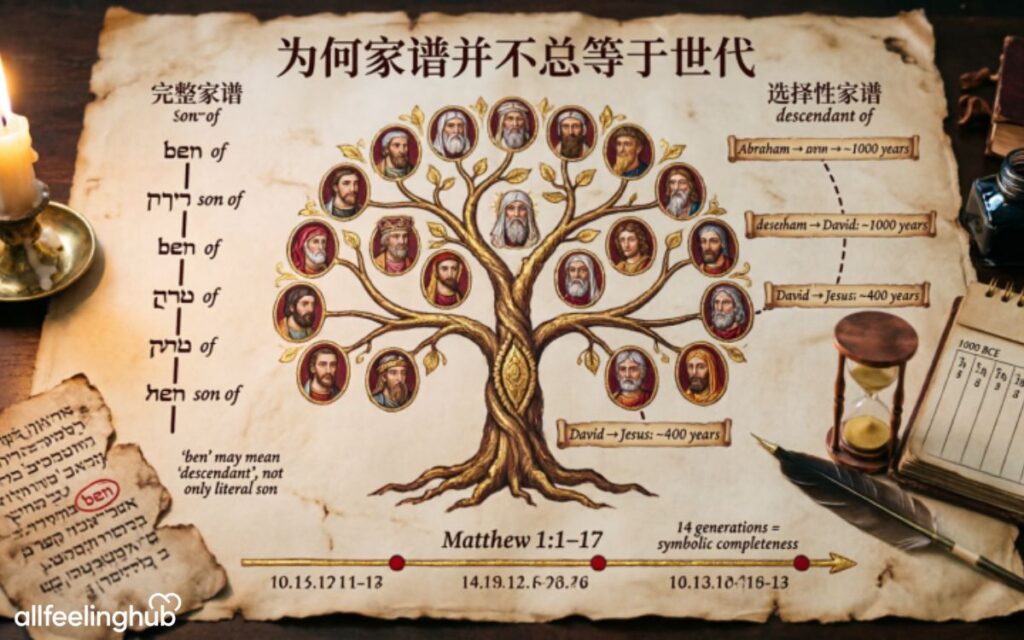
Ancient genealogies, including biblical ones, frequently used selective or telescoped lists — naming only the most significant ancestors rather than every single father-son link — for reasons of memorization, theological emphasis, or literary symmetry (like Matthew’s three sets of 14).
This means counting genealogical entries and assuming each represents one uniform, roughly 20-30-year biological generation will often produce inaccurate timeline estimates, as the Abraham-to-David comparison above demonstrates.
What Does the Bible Mean by “Generation”?
As covered earlier, the Bible uses “generation” (Hebrew dor, Greek genea) flexibly — to describe a contemporary age group, a stage in a genealogy, the span of a human lifetime, or even a moral/spiritual category of people, depending on the passage.
There is no single technical definition that applies uniformly across all of Scripture.
How Long Is a Generation Biblically?
As addressed at the start of this guide, the most commonly cited figures are 40 years (the wilderness generation), 70-80 years (ordinary human lifespan per Psalm 90), and roughly 100 years (implied by Genesis 15’s 400-years-over-four-generations prophecy) — with the correct figure depending entirely on which biblical passage and context is being discussed.
How Long Was a Generation in Biblical Times?
Historically, ordinary biological generations in the ancient Near East — the actual average gap between a parent’s and child’s birth — are generally estimated by historians and demographers at around 20-30 years, similar to pre-modern generational gaps elsewhere in the ancient world.
This is shorter than most of the numbers Scripture associates with “a generation” in a literary or theological sense, reinforcing that biblical generation language usually serves a purpose other than strict biological tracking.
Why the Length of a Biblical Generation Matters
Getting a sense of how the Bible uses “generation” matters for several reasons: it affects how readers interpret prophetic statements like Matthew 24:34, it shapes how genealogies like Matthew 1 or Genesis 5 should be read (as complete records or theological structures), and it helps guard against speculative end-times calculations that assume a fixed, precise “generation length” the biblical text never actually specifies.
Can We Calculate a Generation From Biblical Lifespans?
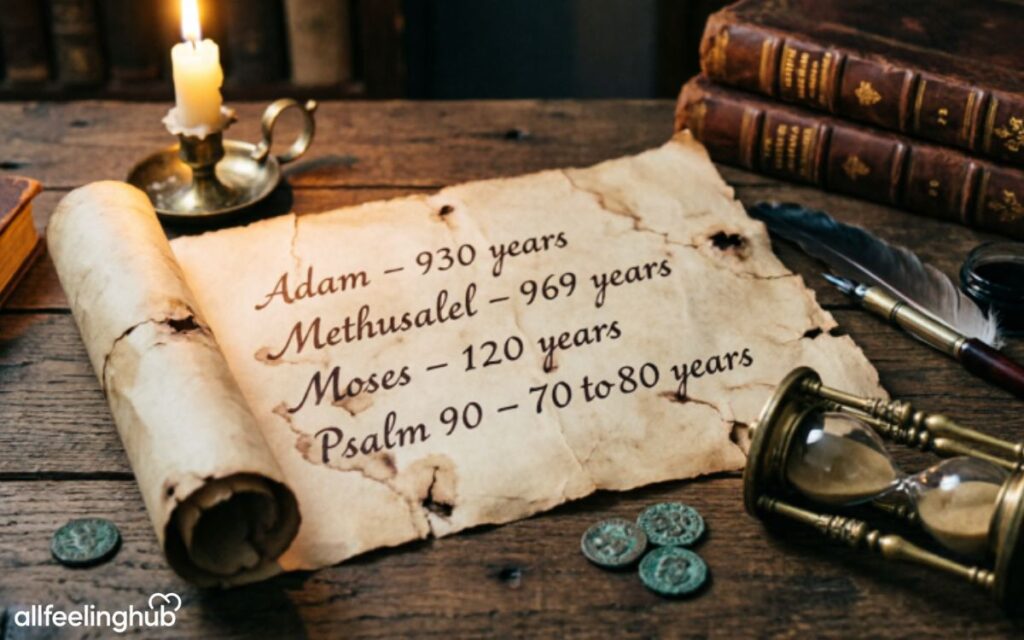
To some extent, yes — Psalm 90:10’s figure of 70-80 years gives a reasonable biblical anchor for “one lifetime,” and the wilderness narrative’s 40-year figure gives a useful anchor for “the remaining lifespan of an adult cohort.
” But calculating a single universal “generation length” from these figures runs into trouble quickly, since biblical lifespans vary dramatically across different eras of the text — the patriarchs before Abraham are recorded as living many centuries (Genesis 5), a figure most readers understand symbolically or historically differently than the more human-scale lifespans described from Abraham onward.
How Long Is a Generation in the Bible Compared With Today?
As discussed above, the Bible’s usage is broader and less standardized than the modern demographic concept of a generation.
Where today’s usage tends to define a generation narrowly (15-20 years, tied to birth cohorts), biblical usage ranges anywhere from an entire lifespan (70-80 years) down to the more loosely applied 40-year figure, depending entirely on context — making direct, one-to-one comparison with modern generational categories difficult.
Common Misunderstandings About Biblical Generations
- Misunderstanding: The Bible states a generation is exactly 40 years. Reality: 40 years is one recurring figure in specific contexts, not a universal biblical definition.
- Misunderstanding: Matthew’s genealogy (Abraham to Jesus) lists every single ancestor. Reality: it’s a deliberately structured, selective genealogy organized into three sets of 14.
- Misunderstanding: “This generation” in Matthew 24:34 has one agreed-upon meaning. Reality: serious biblical scholars hold at least three different interpretations of this phrase.
- Misunderstanding: You can reliably predict end-times dates by multiplying a fixed generation length by a starting event like 1948. Reality: this approach has produced multiple failed predictions and isn’t directly supported by the biblical text.
Does the Bible Give an Exact Length for a Generation?
No. Nowhere does Scripture state a fixed, universal number of years that defines “a generation” for all purposes.
Instead, different books and contexts use the word to mean different things — sometimes an entire lifespan, sometimes the time for an adult cohort to die out, and sometimes simply “the people living at this time,” without reference to a specific year count at all.
How Generation Length Helps Understand Scripture

Understanding how flexibly the Bible uses “generation” helps readers interpret genealogies more accurately (recognizing when lists are compressed rather than exhaustive), read prophetic statements like Matthew 24:34 with appropriate humility rather than forcing a single calculation onto them, and appreciate the literary and theological purposes behind numbers like 40, 70, and 100 throughout Scripture — rather than treating “generation” as a fixed mathematical unit the biblical authors never intended it to be.
Frequently Asked Questions
How Long Is a Generation in the Bible?
A biblical generation is often understood as about 40 years, although the Bible uses the word in different contexts.
Is a Generation 40 Years in the Bible?
Yes, 40 years is strongly associated with a generation in passages describing Israel’s wilderness journey, such as Numbers 32:13.
Does the Bible Say a Generation Is 70 Years?
Psalm 90:10 says human life may reach 70 years, or 80 with strength, but this verse refers primarily to lifespan rather than defining a generation.
Why Is 40 Years Considered a Biblical Generation?
The 40-year period is significant because the Israelites wandered in the wilderness for 40 years before entering the Promised Land.
Can a Biblical Generation Be 20 Years?
Yes, the meaning can vary depending on context, and some biblical passages use “generation” more broadly for a group of people living during a particular period.
What Does “This Generation” Mean in the Bible?
“This generation” can refer to people living at a particular time, especially in Jesus’ teachings, rather than always meaning a fixed number of years.
How Many Years Is Three Generations in the Bible?
If using the commonly cited 40-year estimate, three generations would be approximately 120 years, though biblical usage is not always this precise.
How Many Years Is a Generation in Biblical Prophecy?
There is no single fixed number for a generation in biblical prophecy, so the surrounding passage and historical context are important.
What Is the Difference Between a Biblical Generation and a Human Lifespan?
A generation describes a period or group of people, while a lifespan refers to how long an individual person lives.
What Is the Best Biblical Answer for the Length of a Generation?
There is no universal fixed length, but 40 years is a commonly used biblical reference, while other passages show that “generation” can have different meanings.
Conclusion
How Long Is a Generation in the Bible does not have one fixed numerical answer. Scripture uses the word “generation” in different contexts, and passages such as Psalm 90:10 describe a normal human lifespan as about 70 years, or 80 with strength. Elsewhere, biblical genealogies and historical passages suggest that a generation can represent a different span depending on the context.
Ultimately, the Bible uses “generation” more flexibly than a strict modern measurement of time. While 40 years is sometimes associated with a biblical generation because of Israel’s wilderness journey, 70–80 years is also frequently discussed based on Psalm 90:10. The appropriate length therefore depends on the specific passage and purpose, rather than one universal number applying everywhere.

David is a passionate writer with 4 years of experience creating heartfelt prayers, blessings, and inspirational messages. At https://allfeelinghub.com/ , he shares faith-filled content designed to inspire hope, strengthen spirituality, and bring comfort, peace, and encouragement to readers worldwide.