

Many people are curious about the Biblical Meaning of the Name Olivia and whether this beautiful name has a direct connection to Scripture. Although Olivia is not mentioned in the Bible, it has Latin roots and is traditionally associated with the olive tree, a powerful symbol of peace, hope, and blessing.
In this guide, you’ll discover the origin and traditional meaning of Olivia, its connection to the olive tree, and how its symbolism relates to important biblical themes. Whether you’re considering Olivia as a baby name or simply exploring its Christian and spiritual meaning, this article offers a thoughtful look at the history, symbolism, and faith-based significance of the name.
What Does the Name Olivia Mean in the Bible?
The name Olivia doesn’t appear in the Bible, so it has no direct biblical definition. (cite index=”11-1″>Its documented origin is Latin, from the word oliva, meaning “olive” or “olive tree”</cite> — a plant that happens to carry enormous symbolic weight throughout Scripture, from Noah’s dove to the Mount of Olives.
So while “Olivia” itself isn’t a biblical word, the image behind it is one of the Bible’s most consistent and meaningful symbols.
Is Olivia Mentioned in the Bible?
No. There is no person, place, or word “Olivia” anywhere in the Bible, in any translation. (cite index=”15-1″>The name in this exact form was first used by William Shakespeare for a character in his 1602 comedy Twelfth Night</cite>, more than 1,500 years after the New Testament was written.
Does Olivia Have a Biblical Meaning?
Not directly, since the name itself is post-biblical and Latin rather than Hebrew or Greek. But because Olivia means “olive,” and the olive is one of Scripture’s most significant recurring symbols — of peace, provision, anointing, and covenant — many Christians find a genuine, well-supported thematic connection here, more so than with names whose “biblical meaning” rests on invented or coincidental etymology.
The Origin and History of the Name Olivia
(cite index=”12-1″>Olivia comes from the Latin Olīva, originally an early saints’ name derived from olīva, meaning “olive” or “olive branch.”</cite> (cite index=”13-1”>Both Oliva and the rarer Olivia were in occasional use in English-speaking countries as early as the 13th century, though the more common vernacular form at the time was simply Olive</cite>.
(cite index=”15-1″>Shakespeare’s use of the name for a noblewoman in Twelfth Night (1602) — possibly influenced by the earlier Oliva or by the male name Oliver — is credited with popularizing the form we use today</cite>, though it remained relatively rare until the 20th century.
Olivia Meaning in Hebrew
Olivia has no Hebrew origin. It’s a Latin name, and its root word oliva comes from Latin and ultimately Proto-Indo-European roots, not from Hebrew vocabulary.
That said, the olive tree itself (Hebrew zayit, זַיִת) is deeply woven into the Hebrew Bible — appearing in Genesis, the Psalms, and the Prophets — which is part of why Olivia’s underlying image, if not the name itself, resonates so naturally with Hebrew scriptural symbolism.
Olivia Meaning in Greek
Olivia has no direct Greek origin either, though the Greek word for olive, elaia (ἐλαία), is the root of the Mount of Olives’ name (Elaion Oros) and of Gethsemane, meaning “oil press,” referenced throughout the New Testament (Matthew 26:36, Luke 22:39).
While Olivia itself isn’t Greek, its symbolic core connects meaningfully to this important New Testament geography and imagery.
Is Olivia a Hebrew or Biblical Name?
No — Olivia is Latin, not Hebrew, and it doesn’t appear in the Bible as a name. It belongs in the same category as many beloved names used by Christian families today (Charlotte, Amelia, William) that carry no biblical pedigree of their own, even when — as with Olivia — their underlying meaning connects naturally to genuine scriptural imagery.
Spiritual Meaning of the Name Olivia
Olivia’s spiritual meaning draws directly on the olive’s documented biblical symbolism: peace (the olive branch brought back by Noah’s dove, Genesis 8:11), provision (olive oil as a staple of ancient Israelite life), and anointing (olive oil used to consecrate priests and kings throughout the Old Testament).
Because this connection runs through the name’s actual, literal meaning rather than a coincidental sound-alike, Olivia carries an unusually direct link to biblical symbolism for a name that isn’t itself found in Scripture.
Christian Meaning and Significance of Olivia
Christian parents who choose Olivia often connect it explicitly to peace and God’s provision, drawing on the olive branch’s status as history’s most recognizable peace symbol — rooted directly in Genesis 8:11, when the dove returned to Noah’s ark carrying “an olive leaf pluckt off” as the first sign that God’s judgment had passed and new life could begin.
Biblical Symbolism Associated With Olivia
The olive appears throughout Scripture in several distinct symbolic roles: as a sign of peace and renewal (Genesis 8:11), as the source of oil used for anointing kings and priests (Exodus 30:22-25, 1 Samuel 16:13), as an image of prosperity and blessing (“thy children like olive plants round about thy table,” Psalm 128:3), and as a metaphor for God’s covenant people (Romans 11:17-24, Paul’s extended image of Gentile believers being “grafted in” to Israel’s olive tree).
What Does Olivia Symbolize Spiritually?
Spiritually, Olivia tends to symbolize peace, steady provision, and covenant faithfulness — themes drawn directly from the olive’s recurring biblical role rather than from any invented etymology.
It’s also associated with resilience, since olive trees are famously long-lived and capable of regrowing even after being cut down or burned, a detail some Christians connect to biblical themes of restoration and endurance.
Bible Verses That Reflect Olivia’s Meaning
- Genesis 8:11 – “…and, lo, in her mouth was an olive leaf pluckt off: so Noah knew that the waters abated from off the earth.”
- Psalm 52:8 – “But I am like a green olive tree in the house of God: I trust in the mercy of God for ever and ever.”
- Psalm 128:3 – “…thy children like olive plants round about thy table.”
- Romans 11:17 – “And if some of the branches be broken off, and thou, being a wild olive tree, wert grafted in among them…”
- Zechariah 4:3 – “And two olive trees by it, one upon the right side of the bowl, and the other upon the left side thereof.”
- James 3:12 – “Can the fig tree, my brethren, bear olive berries?…”
Olivia Name at a Glance
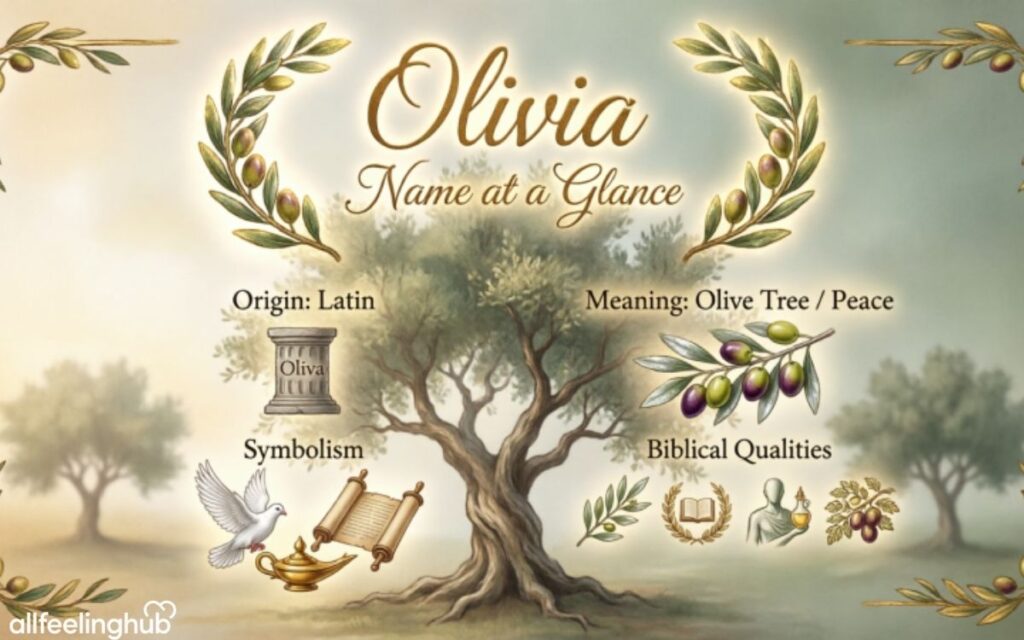
| Detail | Information |
| Documented origin | Latin (oliva, “olive” or “olive tree”) |
| Popularized by | William Shakespeare, Twelfth Night (1602) |
| Biblical origin | None — the name does not appear in Scripture |
| Hebrew/Greek origin | None (though the olive itself is central to Hebrew and Greek biblical imagery) |
| Underlying symbolism | Peace, provision, anointing, covenant, renewal |
| Gender | Feminine |
| Common variants | Olive, Livia, Liv, Ollie, Olivette, Alivia |
| Modern popularity | Ranked #1 girls’ name in the U.S. as of 2024 |
Biblical Qualities Associated With the Name Olivia
Given the olive’s biblical symbolism, Olivia is commonly associated with qualities Scripture links to it directly: peace, steady faithfulness, fruitfulness, and resilience through hardship.
These qualities are drawn from a consistent, well-documented pattern across both Old and New Testament texts, giving Olivia a more grounded basis for “biblical qualities” than names whose associations rely on folk etymology alone.
Olivia and the Symbolism of the Olive Tree
The olive tree holds a uniquely central place in biblical symbolism, appearing from Genesis through the Epistles.
It represents peace after judgment (Noah’s dove), consecration and calling (anointing oil), provision and daily sustenance (olive oil as a staple food and fuel source throughout the ancient Near East), and — in Paul’s extended metaphor in Romans 11 — the ongoing, grafted relationship between Israel and the Gentile Church.
Olivia and the Biblical Meaning of Peace
The olive branch’s association with peace is one of the most enduring images in both biblical and broader Western culture, tracing directly back to Genesis 8:11, when the dove’s return with an olive leaf signaled the end of God’s judgment through the Flood and the start of renewed life on earth.
This single image has shaped peace symbolism for thousands of years — meaning Olivia carries, through its literal meaning, one of Scripture’s clearest and most universally recognized pictures of reconciliation and hope.
Olivia as a Symbol of Hope and Renewal
Beyond peace specifically, the olive branch functions in Genesis as a symbol of hope and renewal after catastrophe — the first tangible evidence Noah receives that life could begin again after the Flood.
Olive trees are also known for their remarkable ability to regrow from their roots even after being cut down or burned, a natural characteristic some Christian commentators connect to biblical themes of restoration, as in Job’s meditation on trees that can sprout again even after being cut down (Job 14:7-9).
Olivia and Christian Faith
Olivia carries no built-in doctrinal content, but its documented meaning — olive, and everything the olive represents throughout Scripture — sits unusually comfortably alongside core Christian teaching on peace, provision, and covenant faithfulness, giving it a more direct spiritual resonance than many popular baby names marketed as “biblical.”
Is Olivia Considered a Christian Name?
Not in terms of direct biblical origin, though it has a longer Christian pedigree than many secular names: (cite index=”12-1″>Oliva was used as an early Christian saint’s name in medieval Europe</cite> well before Shakespeare’s more famous literary use.
Its wide adoption by Christian families across Europe and the English-speaking world over the following centuries has made it a thoroughly familiar name within Christian culture, even without a direct scriptural source.
The Olive in Scripture — Key Biblical References
| Reference | Symbolic Meaning |
| Genesis 8:11 | Peace and renewal (Noah’s dove and the olive leaf) |
| Exodus 30:22-25 | Anointing oil for priests and the tabernacle |
| 1 Samuel 16:13 | Anointing of King David with oil |
| Psalm 52:8 | Steadfast trust in God (“a green olive tree in the house of God”) |
| Psalm 128:3 | Blessing and fruitful family life |
| Zechariah 4:3, 11-14 | Two olive trees as a symbol of divinely empowered leadership |
| Romans 11:17-24 | Gentile believers “grafted in” to God’s covenant people |
| Matthew 26:36 / Luke 22:39 | The Mount of Olives and Gethsemane, site of Jesus’ prayer before the Crucifixion |
Can Olivia Have Spiritual Meaning Without Being Biblical?
Yes — and Olivia is a particularly strong example of this, since its literal meaning (“olive”) connects directly to one of the Bible’s richest and most consistent symbols, even though the name itself postdates Scripture by over a millennium.
A name doesn’t need to appear in the biblical text to carry real spiritual weight; here, that weight comes from a well-documented image rather than an invented etymological leap.
Olivia in Christian History and Tradition
Beyond its early use as the saint’s name Oliva in medieval Europe, Olivia doesn’t have a dedicated feast day or major hagiographical tradition of its own tied specifically to that spelling.
Its larger legacy within Christian history comes instead through centuries of ordinary Christian families across Europe and, later, North America choosing the name for its gentle sound and its resonance with the olive’s peaceful, hopeful symbolism.
Olivia in European Naming Traditions
(cite index=”15-1″>Olivia appears across Europe in closely related forms: Olivija (Croatian, Slovene, Lithuanian), Olívie (Czech), Olívia (Hungarian, Portuguese, Slovak), Olīvija (Latvian), Oliwia (Polish), and Oliviya (Russian, Ukrainian)</cite> — each tracing back to the same Latin oliva root, reflecting the olive tree’s broad, shared cultural and religious significance across historically Christian Europe.
Olivia Name Meaning for Girls
Olivia has been used almost exclusively as a feminine name since its earliest documented use, with (cite index=”13-1″>its male counterpart Olivio remaining rare by comparison</cite>.
It has become one of the most popular girls’ names in the English-speaking world in recent decades, (cite index=”14-1″>ranking as the number one girls’ name in the United States as of 2024</cite>.
Olivia vs. Olive: Meaning and Differences
Olivia and Olive share the exact same Latin root and meaning — both derive directly from oliva. (cite index=”13-1″>Olive was actually the more common vernacular English form for centuries before Olivia became widely popular</cite>, meaning Olive is, in a real sense, the older and more direct English form of the name, while Olivia represents a more formal, Latinate variation later popularized through literature.
Popular Variations and Spellings of Olivia
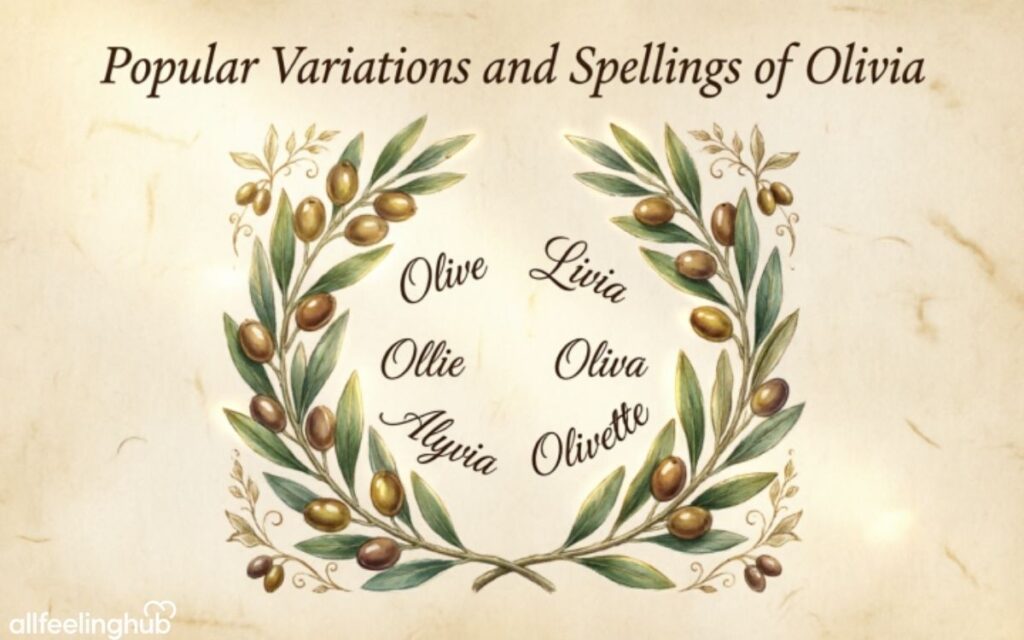
(cite index=”11-1″>Common variants and related names include Olive, Livia, Liv, Ollie, Olivette, and Alivia</cite>.
Internationally, the name also appears as Olivija (Croatian, Slovene, Lithuanian), Olívia (Portuguese, Hungarian, Slovak), Oliwia (Polish), and Oliviya (Russian, Ukrainian) — all rooted in the same Latin word for “olive.”
Personality Traits Associated With the Name Olivia
Popular naming culture associates Olivia with traits like intelligence, grace, and quiet confidence — (cite index=”16-1″>a reputation reinforced by many prominent real and fictional Olivias, from Olivia de Havilland and Olivia Colman to Olivia Pope and Olivia Benson, most of whom are portrayed as capable, composed, and “unmistakably in charge.
Biblical Names Similar to Olivia
While no biblical name shares Olivia’s exact Latin etymology, a few carry meaningful thematic overlap:
- Shalom-rooted names – Hebrew for “peace,” directly related to the peace symbolism Olivia carries through the olive branch.
- Deborah – Hebrew for “bee,” associated with the productive, provision-oriented imagery similar to the olive’s role as a food and oil source.
- Zetta or names built on zayit — the Hebrew word for “olive tree” itself, offering a genuinely Hebrew alternative for parents wanting the olive’s meaning with authentic biblical-language roots.
Names Related to Peace and the Olive Tree
For parents drawn to Olivia’s peace symbolism but wanting a name with a direct Hebrew or biblical root, a few strong options exist:
- Shalom – the Hebrew word for “peace” itself, used throughout the Old Testament.
- Salome – related to the Hebrew root for “peace,” a name appearing in the New Testament (Mark 15:40, 16:1).
- Irene – Greek for “peace,” a name used by early Christians and later saints.
- Noa/Noah-related names – while Noah’s name itself means “rest” or “comfort” rather than “peace,” his story is the direct biblical source of the olive branch’s peace symbolism.
Why Christian Parents Choose the Name Olivia
Christian parents often choose Olivia for its gentle, classic sound, its consistent modern popularity, and — distinctively among “biblical name” searches — its genuinely well-grounded connection to the olive branch’s peace symbolism from Genesis 8.
Others are drawn to its literary elegance through Shakespeare or simply love the name on its own merits, independent of any deeper meaning.
Is Olivia a Good Christian Baby Name?
Yes, by any reasonable standard. The Bible doesn’t require Christian parents to choose only names that appear in Scripture, and Olivia — currently one of the most popular girls’ names in the English-speaking world — carries a meaningfully authentic connection to biblical symbolism through its literal meaning, even without appearing as a name in the text itself.
What the Bible Teaches About Names and Identity
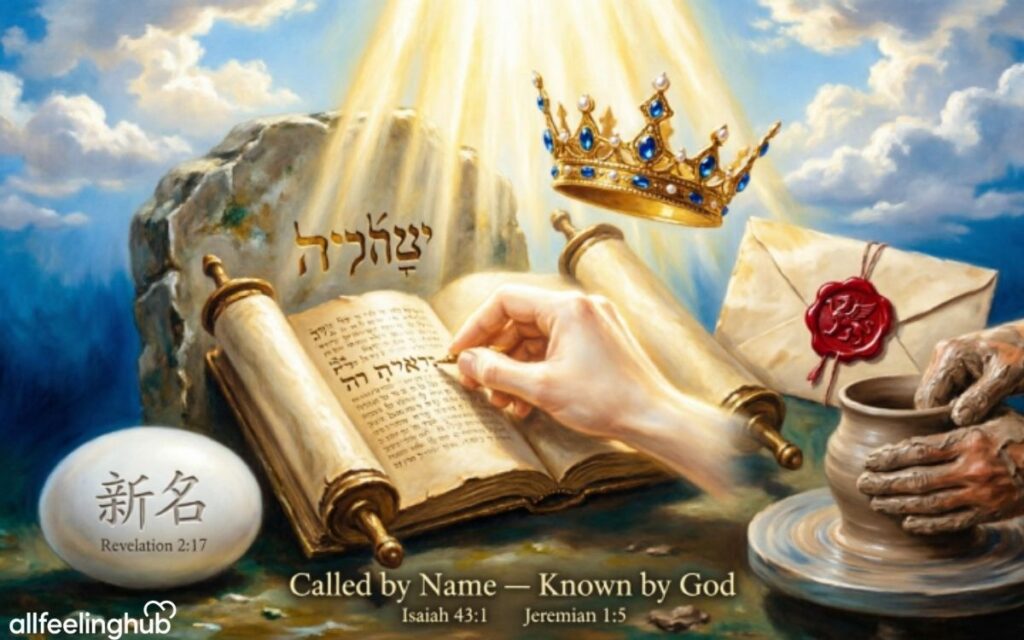
Scripture treats names as significant — but significant because of what they represent about a person’s character, calling, or relationship with God, not merely because of a name’s linguistic origin.
God renames Abram to Abraham (Genesis 17:5) and Jacob to Israel (Genesis 32:28) to mark a change in identity and purpose; Simon becomes Peter, “the rock” (Matthew 16:18).
Frequently Asked Questions
What Is the Biblical Meaning of the Name Olivia?
Olivia is not mentioned in the Bible, so it has no direct biblical meaning. The name is traditionally associated with the olive tree, which has strong biblical symbolism connected with peace, blessing, and abundance.
Is Olivia Mentioned in the Bible?
No, Olivia does not appear as a personal name in the Bible.
Is Olivia a Biblical Name?
No, Olivia is not a biblical name, but its association with the olive tree gives it meaningful biblical symbolism.
What Is the Hebrew Meaning of Olivia?
Olivia has no direct Hebrew meaning because it comes from Latin origins. However, the olive tree is significant in the Bible and can symbolize peace, prosperity, and God’s blessing.
What Is the Spiritual Meaning of Olivia?
Spiritually, Olivia can represent peace, hope, growth, fruitfulness, and a life rooted in faith.
What Does the Olive Tree Symbolize in the Bible?
The olive tree is associated with peace, blessing, prosperity, anointing, and God’s provision throughout biblical Scripture.
Is Olivia a Good Christian Name?
Yes, Olivia can be a beautiful Christian name because its connection to the olive tree carries positive biblical symbolism.
What Bible Verses Relate to the Name Olivia?
Verses mentioning olive trees or olive oil can provide biblical connections to Olivia, including Psalm 52:8 and Psalm 128:3.
What Personality Traits Are Associated With Olivia?
Olivia is often associated with kindness, peace, grace, compassion, strength, and a nurturing personality.
Why Do Parents Choose the Name Olivia?
Parents often choose Olivia because it has an elegant, timeless sound and a meaningful association with the olive tree and its biblical symbolism.
Conclusion
Biblical Meaning of the Name Olivia is a beautiful topic for anyone exploring the spiritual significance behind this popular name. Olivia is not directly mentioned in the Bible and does not have a Hebrew or biblical origin. The name comes from Latin oliva, meaning “olive” or “olive tree,” which gives it meaningful biblical symbolism because the olive tree and olive oil appear frequently throughout Scripture.
Although Olivia has no direct biblical meaning, its connection with the olive can represent peace, blessing, fruitfulness, and spiritual richness. The olive branch is widely associated with peace, while olive oil was used in biblical times for anointing and sacred purposes. For this reason, Olivia can carry beautiful spiritual symbolism while remaining a graceful and timeless name.

David is a passionate writer with 4 years of experience creating heartfelt prayers, blessings, and inspirational messages. At https://allfeelinghub.com/ , he shares faith-filled content designed to inspire hope, strengthen spirituality, and bring comfort, peace, and encouragement to readers worldwide.